Fence Calculator
Use this fence calculator to calculate material for each fence run. The result gives posts, fence sections, pickets, panels, wire, concrete bags, and cost.
Fence calculator input
Put each fence run and the material dimensions in the calculator. The result includes posts, fence material, concrete, and cost.
Fence runs
Put each continuous run in the calculator. Stop a run at a corner, gate, or fence end. Do not include gate openings.
Post holes and cost
Calculate fence materials
Measure each continuous run separately. A run stops at a corner, gate, or fence end. Do not include a gate opening in the run length. This method gives the section quantity for each fence part.
- 1. RunsMeasure each continuous fence run. Stop at a corner, gate, or fence end.
- 2. MaterialsSelect pickets, panels, or wire. Put the product dimensions in the calculator.
- 3. PostsPut in the end posts, corner posts, and gates. Read the run endpoint message.
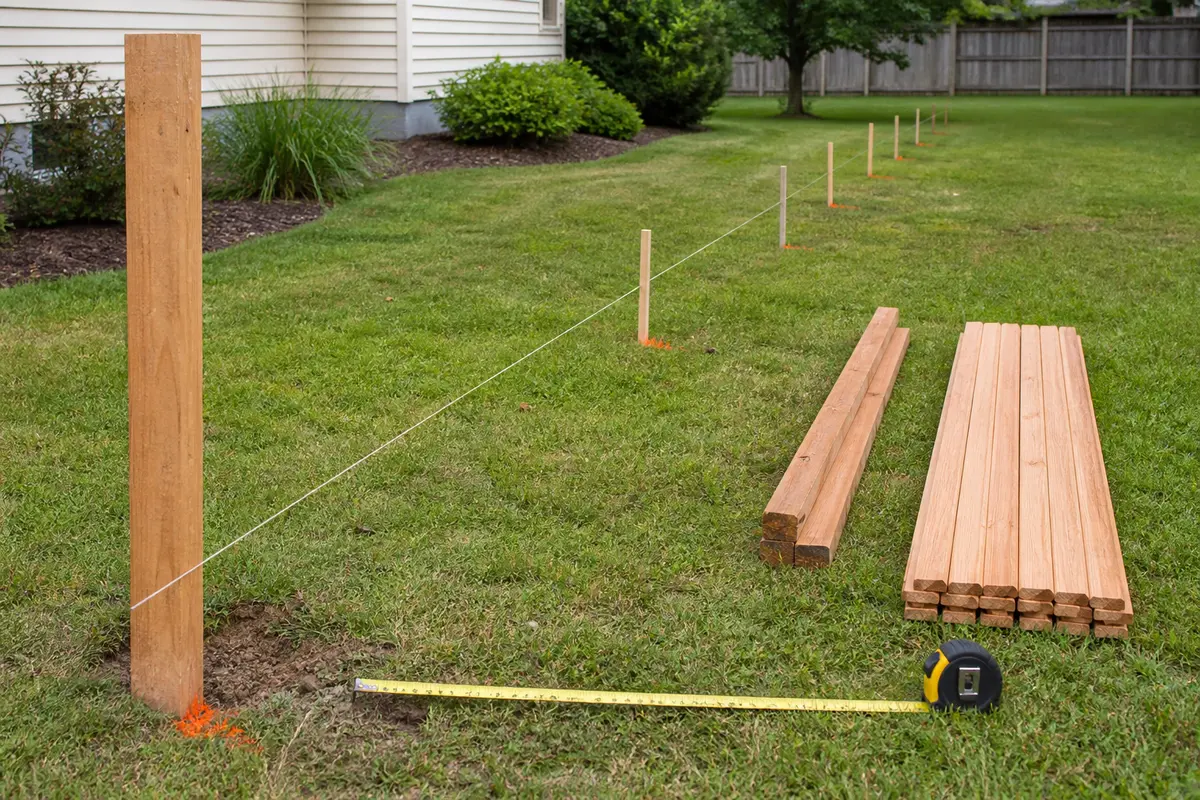
Measure along the fence line. Identify each corner and gate before you put in the run lengths.
Material types
Pickets
Put the measured picket width and the gap in the calculator. The calculator gives the picket quantity and the rail quantity.
Panels
Put the measured panel width in the calculator. Full panels keep this width. Cut the last panel in a run when necessary.
Wire or mesh
Put the wire runs and the roll length in the calculator. Use one wire run for a continuous mesh roll.
Posts for one straight run
The table includes two end posts. Calculate each side of a fence separately.
| Run | 6 ft maximum | 8 ft maximum | 10 ft maximum |
|---|---|---|---|
| 50 ft | 10 posts | 8 posts | 6 posts |
| 100 ft | 18 posts | 14 posts | 11 posts |
| 150 ft | 26 posts | 20 posts | 16 posts |
Post endpoint check
Each run has two endpoints. One end post uses one endpoint. One corner post connects two endpoints. Each gate adds two gate posts. The calculator compares these positions with the number of run endpoints.
If the quantities do not agree, do a check of the corner, gate, and fence-end quantities. Make sure that each gate opening is between two runs.
Example
A straight 100 ft picket fence has an 8 ft maximum post spacing. Thus, 13 sections and 14 posts are necessary. This fence uses 214 pickets that are 5.5 in wide with a 0.125 in gap. Three rails per section give 39 rails. The quantities with 10% more material are 16 posts, 236 pickets, and 43 rails.
Questions about the fence calculator
Method and limits
The calculator gives a whole section quantity for each run. It removes the gravel depth from the concrete depth and post embedment. Then it subtracts the square post volume from the cylindrical hole volume. It uses the specified bag yield. Product instructions, wind loads, soil, frost depth, and local requirements can change the design.
References and related tools
The QUIKRETE post-setting instruction gives initial hole dimensions. In the United States, contact 811 before excavation. Use the post hole concrete calculator to calculate the footing. Use the dirt calculator for soil from excavation.