Mortar vs Concrete
Mortar glues bricks and blocks together. Concrete is the structure itself. The quickest way to tell them apart: concrete has gravel in it.
By Marcus Delgado, concrete estimator · Updated October 2026
- Gravel
- The ingredient only concrete has
- 4,000 psi
- Bagged concrete mix at 28 days
- 750 psi
- Type N mortar minimum
- 3/8 in
- Typical mortar joint
What's in each one
- 1 part Portland cement
- 1 part Hydrated lime
- 6 parts Fine sand
Lime keeps it sticky and slow to dry. No stones.
- 1 part Portland cement
- 2 parts Sand
- 3 parts Gravel
Gravel is the backbone. Cement is only about 10–15% of the mix by volume.
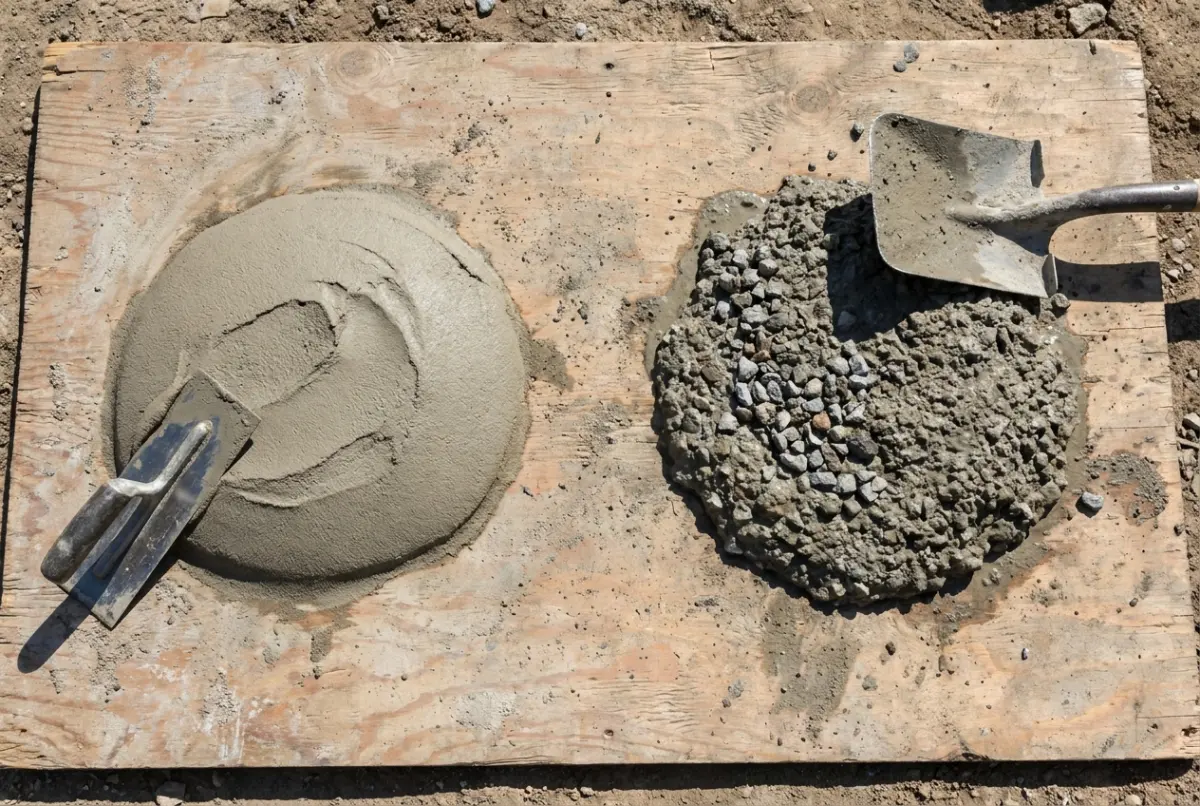
Side-by-side comparison
| Mortar | Concrete | |
|---|---|---|
| Ingredients | Cement + lime + fine sand + water | Cement + sand + gravel + water |
| Job | Bonds bricks, blocks, stone | Is the structure: slabs, footings, posts |
| Strength | 350–2,500 psi (Type N: 750) | About 4,000 psi (bagged mix, 28 days) |
| Water | As much as stays workable | As little as you can place |
| Thickness | 1/4–1/2 in joints | Usually 3½ in and thicker |
| Yield | 60 lb bag ≈ 0.45 cu ft | 80 lb bag ≈ 0.60 cu ft |
| Working time | Use within 2½ hours | Place promptly (ready-mix: within 90 min) |
| Cost (Oct 2026) | ≈ $17 per cu ft | ≈ $13 per cu ft |
Strength minimums from ASTM C270 (mortar) and the QUIKRETE Concrete Mix data sheet. Prices from a retail snapshot; your store will vary.
- Concrete mix (bagged)4,000 psi
- Type M mortar2,500 psi
- Type S mortar1,800 psi
- Type N mortar750 psi
- Type O mortar350 psi
When to use mortar and when to use concrete
- Lay brick or block walls
- Build a mailbox or grill surround
- Set stone veneer
- Repoint cracked joints
- Bed a chimney cap
- Pour a patio, driveway, or shed slab
- Set fence and deck posts
- Pour footings
- Build steps
- Fill large holes and forms
The tell is the gap you're filling. If it's a joint between two pieces of masonry, it's mortar. If you're filling a form or a hole and the material stands on its own, it's concrete.
Can you substitute one for the other?
Mortar instead of concrete: no
Without gravel, mortar shrinks and cracks when it's poured thick. At 750 psi, Type N has under a fifth of the strength of ordinary bagged concrete. Bag makers rate Type N for 1/4–1/2 inch applications, not slabs or posts.
Concrete instead of mortar: no
The stones won't fit in a 3/8-inch joint, and concrete lacks the lime and water retention that make mortar grab the block. The wall would have weak, gappy joints.
Filling block cores: neither, use grout
Block cores, especially around rebar, get masonry grout: fluid enough to flow to the bottom of the core and at least 2,000 psi. Some plans allow pourable concrete; follow the drawings.
Cement vs concrete vs mortar vs grout
The gray powder. An ingredient, never used alone.
Cement + sand + gravel + water. Structural.
Cement + lime + sand + water. Bonds masonry.
Soupy cement + sand (± pea gravel). Fills block cores.
Frequently asked questions
Is mortar stronger than concrete?
No. Mortar is built to be weaker. Standard mortar types range from 350 to 2,500 psi, while a bag of regular concrete mix reaches about 4,000 psi in 28 days. The gravel in concrete is what carries the load.
Can I use mortar mix instead of concrete to set fence posts?
No. Mortar has no gravel and is meant for joints 1/4 to 1/2 inch thick. Set posts with concrete mix or fast-setting concrete. Use the post hole calculator to count bags.
Can I use mortar to make a small slab or patch a step?
Not a slab. For thin patches and toppings under 2 inches, use a sand or topping mix made for that job. For anything structural, like a slab, step, or pad, use concrete mix.
Can I use concrete instead of mortar to lay blocks?
No. The gravel won't fit in a 3/8-inch joint, and concrete doesn't hold water or stick to block the way mortar does. Lay blocks with mortar and fill the cores with grout or concrete per your plans.
What is the difference between cement, concrete, and mortar?
Cement is the gray powder that acts as glue. Concrete is cement + sand + gravel + water. Mortar is cement + lime + sand + water. A bag labeled "cement" alone is only one ingredient. You still have to add sand, and gravel too if you want concrete.
What is grout and how is it different from mortar?
Masonry grout is a soupy mix of cement, sand, and sometimes pea gravel. It's poured into block cores around rebar and must reach at least 2,000 psi (ASTM C476). Mortar holds the blocks together; grout fills them.
Is mortar more expensive than concrete?
Per cubic foot, slightly. In October 2026 we priced premixed mortar around $17 per cubic foot ($7.49 for a 60 lb bag) and bagged concrete around $13 per cubic foot ($7.86 for an 80 lb bag). You use far less mortar, so it rarely drives the budget.
Why does mortar use more water than concrete?
Mortar needs to stay wet and sticky so it bonds to the block, so masons add as much water as keeps it workable. Concrete gets stronger with less water, so you add only enough to place it.
Ready to estimate?
Pouring a slab? Start with the concrete slab calculator.