Type N Mortar
Type N is the everyday mortar for above-ground brick and block. It is medium strength, easy to work, and the bag most DIY walls should start with.
By Marcus Delgado, concrete estimator · Updated October 2026
- 750 psi
- Minimum 28-day strength
- 1 : 1 : 6
- Cement : lime : sand
- ≈ 13 blocks
- Per 80 lb bag (8x8x16)
- 2½ hours
- Use it within, after mixing
How many bags of Type N do I need?
Pick blocks or bricks, type how many, and you get whole bags to buy.
One 80 lb bag lays about 13 blocks (8×8×16) with 3/8 in joints. We added 10% for droppings and the last half-used batch.
Need the block count first? Use the concrete block calculator.
Yields from the QUIKRETE Mortar Mix data sheet (13 blocks or 37 bricks per 80 lb bag). The 60 lb numbers are scaled from it. Brands differ by a block or two per bag.
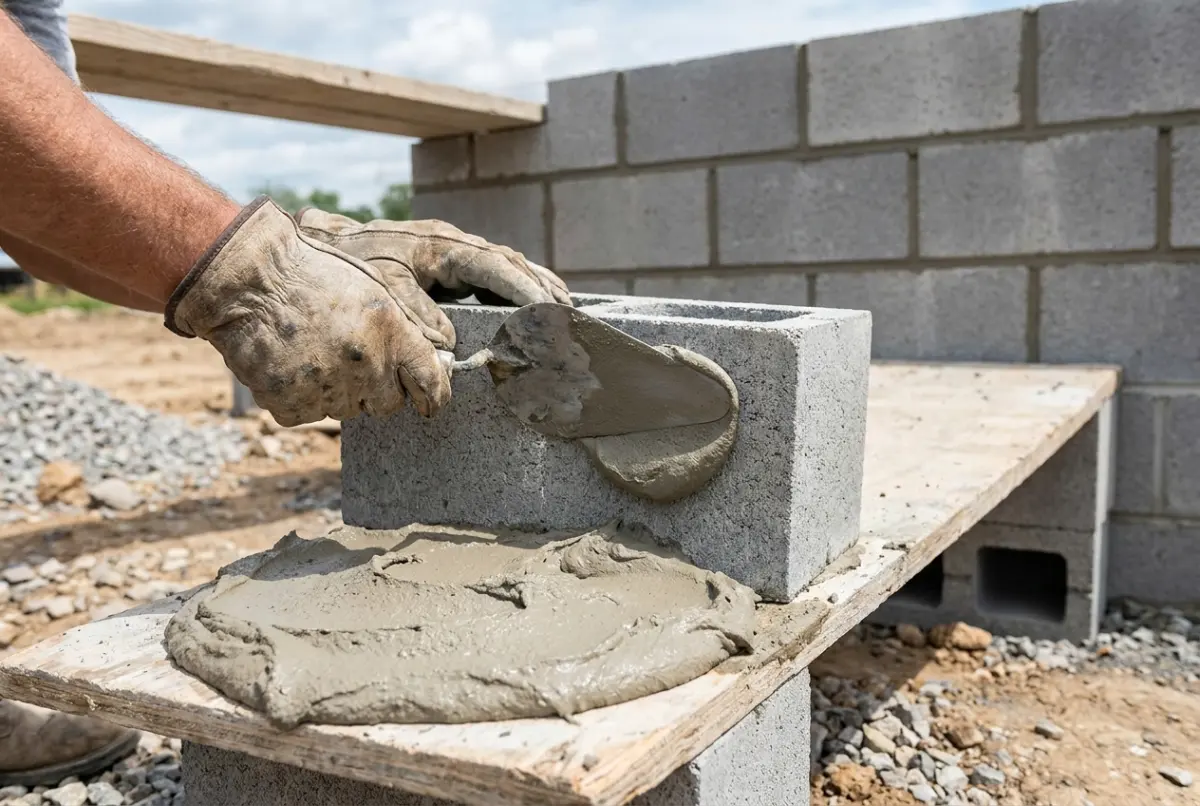
What Type N mortar is made of
All mortar is cement, sand, and water. The lime is what makes Type N creamy, sticky, and forgiving. It holds water so the mortar doesn't dry out on a thirsty block before you set the next one.
- 1 part Portland cement
- 1 part Hydrated lime
- 6 parts Mason sand
ASTM C270 allows ½ to 1¼ parts lime and 2¼–3× as much sand as cement plus lime. 1 : 1 : 6 is the common middle-of-the-road batch.
- 1 part Type N masonry cement
- 3 parts Mason sand
The lime is already in the bag. A 70 lb bag plus about 240 lb of sand makes about 2.75 cu ft of mortar.
Or skip the measuring: premixed mortar mix (QUIKRETE Mortar Mix, Sakrete Type N) already has the sand in it. You only add water. It costs more per wall, but for a few hundred blocks the convenience wins.
Type N vs Type S vs Type M vs Type O
Masons remember the order with MaSoN wOrK: every other letter is a mortar type, strongest first. Stronger isn't always better. Mortar should be weaker than the brick or block, so cracks run through the joints, where they are easy to repoint.
- Type M2,500 psi
- Type S1,800 psi
- Type N750 psi
- Type O350 psi
These minimums apply to lab-prepared samples. ASTM C270 sets no minimum strength for mortar mixed on site.
| Type | Strength | Best for | Avoid for |
|---|---|---|---|
| M | 2,500 psi | Foundations, retaining walls, sewers, exterior mortared paving | Soft or old brick |
| S | 1,800 psi | Below grade, reinforced or load-bearing exterior walls, high wind or seismic areas | Repointing soft brick |
| N | 750 psi | Above-grade walls, brick veneer, chimneys, parapets, interior load-bearing walls | Below grade, retaining walls, seismic categories D–F |
| O | 350 psi | Interior non-load-bearing walls, repointing soft historic brick | Exterior walls exposed to freeze-thaw |
Based on Brick Industry Association Technical Note 8B. Your plans or local code override this table.
Where to use Type N (and where not)
- Above-grade block and brick walls
- Brick veneer on a house
- Chimneys and parapets above the roof
- Interior load-bearing walls and partitions
- Repointing newer brickwork
- Glass block (Type N or S)
- Foundation and basement walls (use S or M)
- Retaining walls (use S or M)
- Mortared patios and walks outdoors (use M)
- Fireboxes (use refractory mortar)
- Filling block cores (use grout)
- Pouring a slab or setting posts (use concrete)
Type N is also excluded from earthquake-resisting walls in seismic design categories D, E, and F. Much of California, the Pacific Northwest, Alaska, and the New Madrid area around Memphis fall in those categories. That's engineered work, so the drawings will name the mortar.
Bag yields by brand
| Product | Bag | 8 in blocks | Bricks | Water |
|---|---|---|---|---|
| QUIKRETE Mortar Mix (Type N) | 80 lb | ≈ 13 | ≈ 37 | ≈ 5 qt |
| Sakrete Mortar Mix Type N | 80 lb | ≈ 12 | ≈ 35 | ≈ 5.3 qt |
| SPEC MIX Masonry Cement & Sand | 80 lb | 11–13 | 40–45 | To workability |
| Midwest Mfg Type N Mortar Mix | 60 lb | ≈ 10 | ≈ 30 | ≈ 1 gal |
| QUIKRETE Type N Masonry Cement + 240 lb sand | 70 lb | ≈ 46 | ≈ 144 | To workability |
Manufacturer figures. Sakrete's yields exclude waste; SPEC MIX's include it. The 10% our calculator adds covers droppings and partial batches.
For bigger jobs, masonry cement plus a pile of sand is the money saver. One cubic yard of mortar takes about 10 bags (70 lb) of Type N masonry cement and about 1.2 tons of mason sand.
How to mix Type N mortar
- 1Wet the toolsRinse the wheelbarrow or mixing tub and the hoe. A dry tub steals water from the first batch.
- 2Add most of the water firstFor an 80 lb bag of QUIKRETE Mortar Mix, start with about 5 quarts of clean water. Keep the last bit back. You can add water, but you can't take it out.
- 3Add the mix and work itPull the dry mix into the water with a hoe. Mix at least 5 minutes, until there are no dry pockets.
- 4Check the consistencyIt should look like soft peanut butter. A ridge you make with the trowel holds its shape, and the mortar hangs on a trowel tipped sideways.
- 5Use it within 2½ hoursAs it stiffens from evaporation, mix in a splash of water. Throw out mortar that has started to set. Never retemper colored mortar, because the color will lighten.
- 6Tool the jointsWhen a thumb pressed into the joint leaves a print without sticking, run the jointer. Brush off the crumbs after they dry a bit more.
Weather limits
Type N works best between 40°F and 90°F. Outside that range, follow the hot- and cold-weather rules from the masonry standard (TMS 602):
| Air temperature | What to do |
|---|---|
| Above 100°F (or 90°F with wind over 8 mph) | Keep mortar under 120°F, use it within 2 hours, fog-spray the wall 3 times a day for 3 days |
| 40–90°F | Normal conditions |
| 32–40°F | Heat the sand or water so the mortar is 40–120°F. Cover new work for 24 hours |
| 20–25°F | Heated mortar plus insulating blankets for 24 hours, windbreaks over 15 mph |
| Below 20°F | Build a heated enclosure and keep the masonry above 32°F for 24 hours |
From CMHA TEK 03-01C. QUIKRETE says not to use its masonry cement below 40°F or if freezing is expected within 48 hours.
Type N or Type S? The Brick Industry Association's answer
Their rule of thumb fits on a sticky note: N for normal, S for stronger. Choose the weakest mortar that meets the job's requirements.
Frequently asked questions
What is Type N mortar made of?
Portland cement, hydrated lime, and sand. The classic recipe is 1 part cement, 1 part lime, and 6 parts damp mason sand by volume. A bag of Type N masonry cement already has the lime in it, so you add 3 parts sand to 1 part masonry cement.
Is QUIKRETE Mortar Mix Type N?
Yes. QUIKRETE Mortar Mix (No. 1102) meets ASTM C270 and C1714 as a Type N mortar. Sakrete sells a bag labeled Mortar Mix Type N. Both are premixed with sand, so you only add water.
Should I use Type N or Type S mortar for block?
Above ground, for a garden wall, veneer, or an interior wall, Type N is the normal choice. Use Type S (or M) for foundation walls, retaining walls, anything below grade, and walls designed to resist earthquakes or high wind. If your plans name a type, use that.
Can I use Type N mortar below grade?
No. Foundation walls, retaining walls, and other masonry in contact with soil should get Type M or Type S. Bag makers say the same: use Type S below grade.
What mortar should I use on old brick?
Use a mortar that is equal to or weaker than the old mortar. Soft, older brick usually gets Type O or a lime mortar. Type N suits newer brickwork. Mortar that is harder than the brick can make the brick faces spall.
How long is Type N mortar good after mixing?
Use it within 2½ hours of the first mix, or about 2 hours in hot weather. You can add a little water to bring back workability (retempering) during that window, except with colored mortar, which lightens when retempered.
How long does Type N mortar take to cure?
Joints are usually ready to tool when they are thumbprint hard. Mortar keeps gaining strength and is tested at 28 days. Protect it from freezing for at least 48 hours, and mist it only when the weather is hot, dry, or windy.
Can I fill concrete block cores with Type N mortar?
No. Block cores, especially ones with rebar, get masonry grout (ASTM C476, 2,000 psi minimum). Grout is far more fluid than mortar and flows around the steel.
Can Type N mortar be used for stucco?
Sakrete says its Type N Mortar Mix can be used for the scratch and brown coats of stucco. QUIKRETE points people to its Base Coat Stucco instead. Follow the label of the bag you buy.
How much does Type N mortar cost?
In October 2026 we found a 60 lb bag of QUIKRETE Mortar Mix for about $7.50 to $9 and a 70 lb bag of Type N masonry cement for about $17. Masonry cement looks pricier, but you add your own sand, so one bag lays roughly 3 to 4 times as many blocks.
Keep going
Building a block wall from scratch? Count the blocks with the block calculator, then come back here for the mortar.
Sources we checked
- CMHA (NCMA) TEK 09-01A: Mortars for concrete masonry, ASTM C270 tables
- Brick Industry Association Technical Note 8B: Mortar selection by use
- Brick Industry Association Technical Note 8: Mortar properties and retempering
- CMHA TEK 03-01C: Hot and cold weather masonry construction
- QUIKRETE Mortar Mix No. 1102 data sheet
- QUIKRETE Masonry Cement Type N data sheet
- Sakrete Mortar Mix Type N technical data sheet
- SPEC MIX Masonry Cement & Sand Mortar yields
- CMHA TEK 09-04A: Grout for concrete masonry