How Much Does a Yard of Sand Weigh?
Short answer first, then a converter for your exact load, a table for 1 to 5 yards, and how to tell if it will fit in your truck.
By Marcus Delgado, concrete estimator · Updated October 2026
- 2,700 lb
- 1 yd³ dry sand (1.35 tons)
- 3,240 lb
- 1 yd³ wet sand (1.62 tons)
- 54 bags
- 50 lb bags in a cubic yard
- 0.74 yd³
- In one ton of dry sand
Sand weight converter
Enter yards or tons, tap dry or wet, and read the answer. If your supplier gives a density, type it in.
1 cubic yard ≈ 1.35 tons (2,700 lb). Metric: 0.76 m³ ≈ 1.22 tonnes.
- Sand (wet)1.62 tons
- Sand (wet, packed)1.75 tons
Weight of 1 to 5 yards of sand
| Cubic yards | Dry sand | Wet sand |
|---|---|---|
| 0.5 yd³ | 1,350 lb (0.68 t) | 1,620 lb (0.81 t) |
| 1 yd³ | 2,700 lb (1.35 t) | 3,240 lb (1.62 t) |
| 2 yd³ | 5,400 lb (2.7 t) | 6,480 lb (3.24 t) |
| 3 yd³ | 8,100 lb (4.05 t) | 9,720 lb (4.86 t) |
| 4 yd³ | 10,800 lb (5.4 t) | 12,960 lb (6.48 t) |
| 5 yd³ | 13,500 lb (6.75 t) | 16,200 lb (8.1 t) |
Dry at 2,700 lb/yd³ (100 lb/ft³), wet at 3,240 lb/yd³ (120 lb/ft³). t = US short tons of 2,000 lb.
Weight by sand type and moisture
- Dry sand, loose2,430 lb
- Mason sand2,600–2,750 lb
- Dry sand (quarry figure)2,700 lb
- Play sand (bagged)≈ 2,700 lb
- Packed (rammed) sand2,835 lb
- Wet sand3,240–3,300 lb
- Wet, packed sand3,510 lb
Quarry, supplier, and engineering-table figures (see sources). Your supplier's scale ticket is the final word.
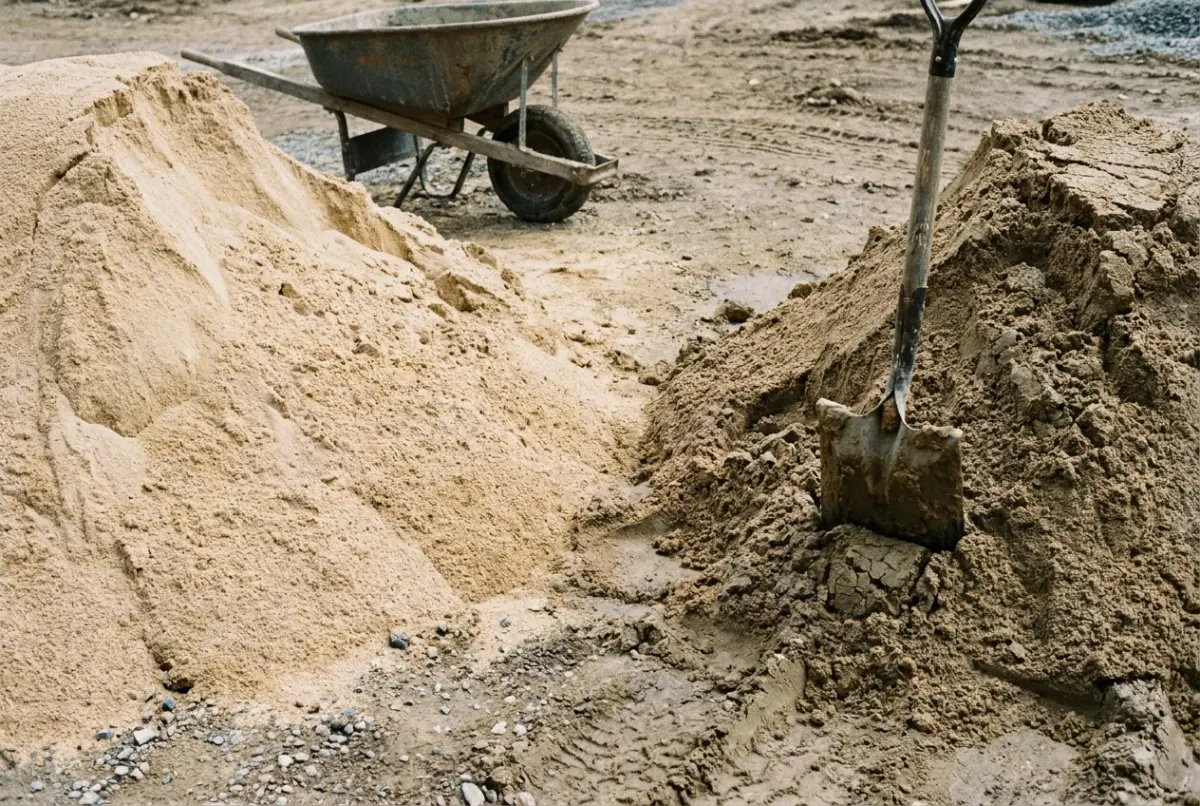
Why wet sand weighs more, but damp sand barely does
Moisture does two things. It adds water weight, and in damp sand it also pushes the grains apart. That second effect is called bulking: a little moisture makes sand take up more room, so a yard of damp sand actually holds less sand.
The two effects roughly cancel out. Damp sand (about 100 lb/ft³) weighs close to the same per yard as dry. Once the sand is soaking wet, water fills the gaps, the bulking collapses, and the weight jumps to 120–130 lb/ft³.
Will it fit in my truck?
Weight, not volume, is the limit. A pickup bed can hold more sand than its springs can carry. Find the payload on the sticker inside the driver's door, then read across:
| Payload rating | Dry sand | Typical vehicle |
|---|---|---|
| 1,000 lb | ≈ 0.37 yd³ | Compact pickup, small utility trailer |
| 1,500 lb | ≈ 0.55 yd³ | Many half-ton pickups |
| 2,000 lb | ≈ 0.74 yd³ | Well-equipped half-ton pickup |
| 3,000 lb | ≈ 1.1 yd³ | Three-quarter-ton pickup |
| 10–16 tons | ≈ 7½–12 yd³ | Single or tandem dump truck |
Divide payload by 2,700 lb per cubic yard. For wet sand, divide by 3,240 instead.
Bags, buckets, and metric
- 50 lb bag (play or all-purpose sand) = 0.5 ft³. 54 bags make a cubic yard.
- 5-gallon bucket = 0.67 ft³, about 65 lb of dry sand. Around 40 buckets fill a cubic yard.
- 1 cubic meter of dry sand ≈ 1,550–1,600 kg. Wet ≈ 1,900 kg.
- 1 US ton = 2,000 lb. 1 metric tonne = 1,000 kg = 2,205 lb.
Frequently asked questions
Is a yard of sand a ton?
No, it's more. A cubic yard of dry sand is about 1.35 US tons (2,700 lb), and wet sand is about 1.6 tons. One ton of dry sand fills only about three-quarters of a cubic yard.
How many cubic yards are in a ton of sand?
About 0.74 cubic yards of dry sand (2,000 ÷ 2,700). For wet sand it's about 0.62 cubic yards. Suppliers often round this to "a ton is about 3/4 of a yard."
How many 50 lb bags of sand make a cubic yard?
54 bags. A 50 lb bag of play or all-purpose sand holds 0.5 cubic feet, and a cubic yard is 27 cubic feet. At about $5 a bag that's roughly $250 to $270 a yard, versus about $30 to $70 for a yard delivered in bulk.
How much does a cubic meter of sand weigh?
About 1,550 to 1,600 kg (1.55 to 1.6 tonnes) when dry. Wet sand runs about 1,900 kg per cubic meter, and saturated, packed sand about 2,080 kg.
How much does half a yard of sand weigh?
About 1,350 lb when dry and about 1,620 lb when wet. That is already near the payload limit of many half-ton pickups.
Can a pickup truck carry a yard of sand?
Often not safely. A yard of dry sand is about 2,700 lb, and many half-ton pickups are rated for 1,500 to 2,000 lb of payload. Check the payload sticker on the driver's door jamb and haul half a yard at a time if needed.
Why does sand weigh more after it rains?
Water fills the spaces between the grains. Fully wet sand is about 20% heavier per cubic yard than dry sand. If you buy by the ton, you are paying for that water.
How much does a yard of sand cost?
Bulk sand typically costs $30 to $70 per cubic yard, or $15 to $50 per ton, plus delivery. Many suppliers have a 1 to 3 ton minimum for delivery.
Related tools
Weighing gravel instead? See how much a yard of gravel weighs.
Sources we checked
- Hedrick Industries tonnage calculator (sand 100 lb/ft³)
- Gorham Sand & Gravel: cubic yards vs tons (sand ≈ 1.3 tons/yd³)
- New Mexico EMNRD material conversion factors (sand 1.45 tons/yd³)
- TRORC cubic yardage weight chart (dry 2,750 lb, wet 3,300 lb)
- Engineering ToolBox: bulk densities of dry, damp, wet, and packed sand
- HomeGuide: sand delivery cost and truckload sizes